
Transit-Time Ultrasonic

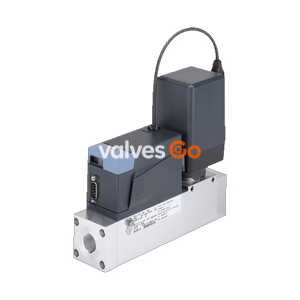
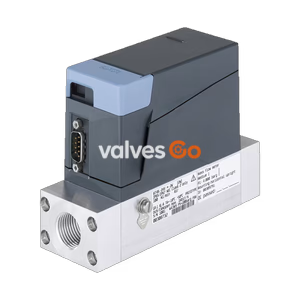
BURKERT 20044278 (Type 8745) mass flow controller and meter for gases. Features 20-2500 lN/min nominal flow, high accuracy, and analogue/Ethernet communication.
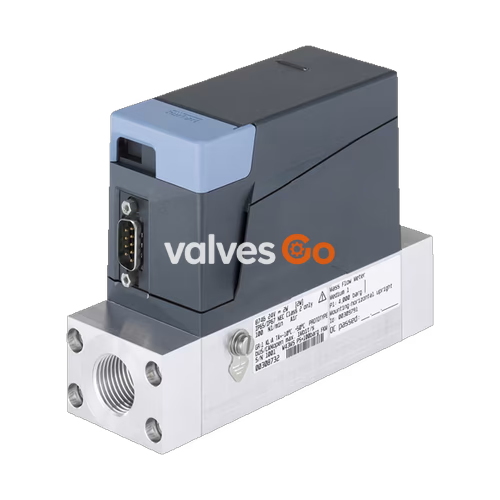
BURKERT 20044278 (Type 8745) is a mass flow controller (MFC) and mass flow meter (MFM) suitable for controlling the mass flow of large gas quantities. The device can be configured as an MFM or MFC according to demand. The thermal inline sensor located directly in the main gas stream achieves very fast response times with minimal pressure loss. As the actuator, a Bürkert direct-acting proportional valve guarantees high response sensitivity. The Type 8745 family is available with electromagnetic or electromotive proportional valves, and supports communication via standard analogue signals, Industrial Ethernet, or Modbus RTU.
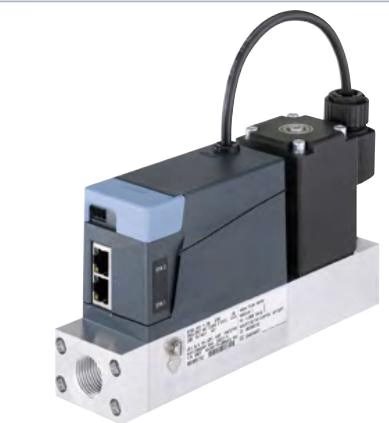
| Property | Description |
|---|---|
| Seal Material | FKM or EPDM (depending on gas) |
| Housing Material | PC (polycarbonate) |
| Base Block Material | Aluminium or stainless steel 1.4404/316L |
| Wetted Parts (Sensor) | Stainless steel 1.4404/316L, Al₂O₃, PPS GF40, epoxy resin, silicon, silicon nitride |
| Operating Voltage | 24 V DC (±10% voltage tolerance, ±2% residual ripple) |
| Operating Medium | Neutral, pure gases (others on request) |
| Medium Temperature | -10 °C to +70 °C (-10 °C to +60 °C with oxygen) |
| Ambient Temperature | -10 °C to +50 °C |
| Degree of Protection | IP20 |
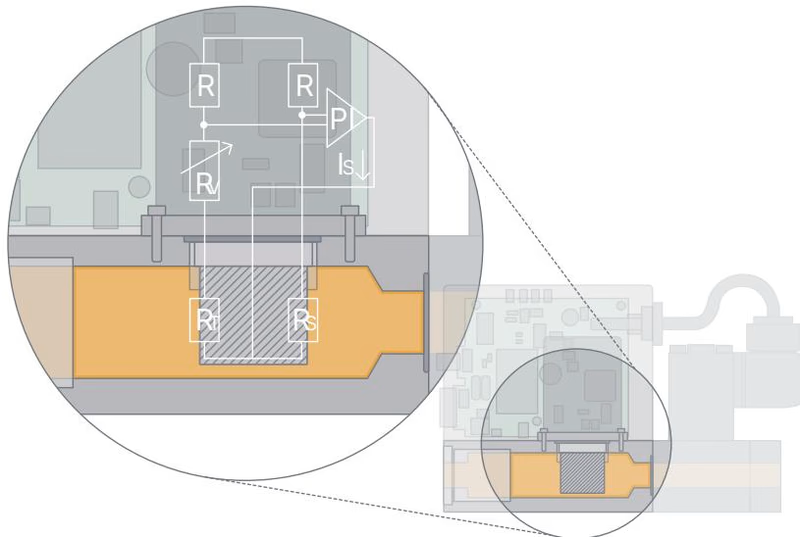
This sensor works as a hot-film anemometer in the CTA (Constant Temperature Anemometer) operational mode. Two resistors with a precisely specified temperature coefficient located directly in the media flow and three further resistors are connected to form a measuring bridge. The first resistor in the gas flow measures the fluid temperature, while the second, low-value resistor is always heated just enough to keep it at a fixed, specified excess temperature with respect to the fluid temperature. The heating current required for this is a measure of the heat dissipation and represents the primary measured variable.
All values refer to 1013.25 mbar abs and 273.15 K (0 °C).
| Gas | Min. QN [l/min] | Max. QN [l/min] |
|---|---|---|
| Acetylene | 20 | 320 (from 65 l/min with air calibration) |
| Ammonia | 8 | 1000 |
| Argon | 20 | 1600 |
| Carbon dioxide | 20 | 800 |
| Air | 20 | 2500 |
| Methane | 20 | 1200 |
| Propane | 20 | 200 |
| Oxygen | 20 | 2500 |
| Nitrogen | 20 | 2500 |
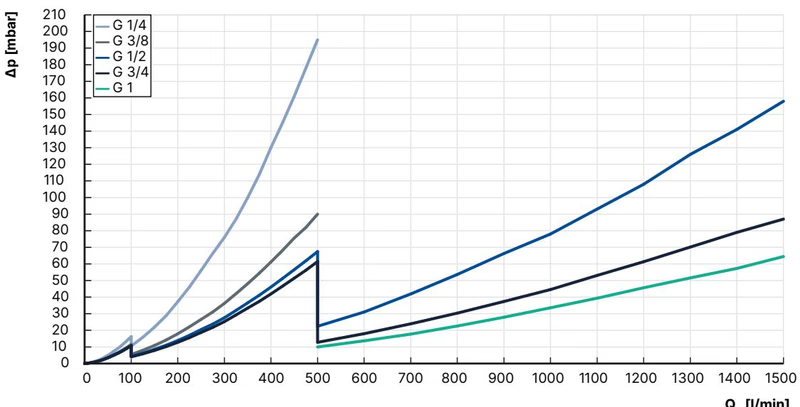
The diagram shows an example of the pressure loss curves with air flowing through. To determine the pressure loss of other gases, the corresponding air equivalent must first be calculated and the base block used for the other gas must be taken into account.
Safety Information
Explore similar products in our catalog