
Transit-Time Ultrasonic

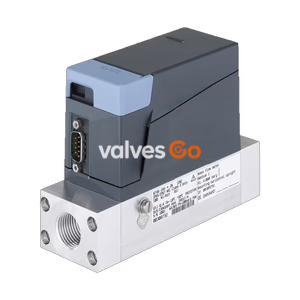
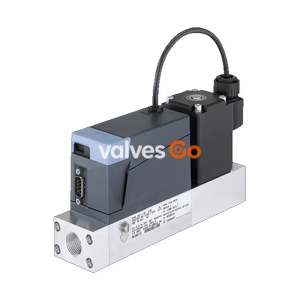
Burkert Type 8745 Mass Flow Controller (MFC) and Meter (MFM) for gases. Features high accuracy, fast response, and communication via standard signals or Industrial Ethernet.
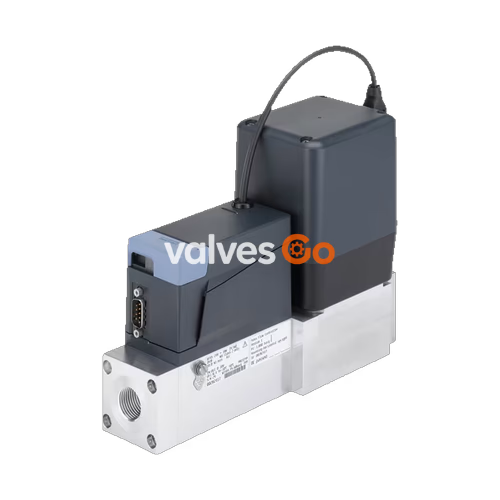
Burkert Type 8745 Mass Flow Controller (MFC) and Mass Flow Meter (MFM) is suitable for controlling the mass flow of large gas quantities. Type 8745 can be configured as MFM or MFC according to demand. Optionally, up to four calibration curves can be stored in the device. The thermal inline sensor located directly in the main gas stream achieves very fast response times with minimal pressure loss. As the actuator, a Burkert direct-acting proportional valve guarantees high response sensitivity.
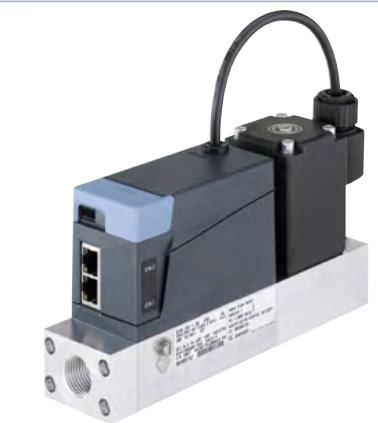
As an MFC, Type 8745 is available in two variants: with an electromagnetic proportional valve and with an electromotive proportional valve. In addition to an analogue and an Industrial Ethernet variant, a Modbus RTU variant is also available.
| Product properties | Description |
|---|---|
| Seal | FKM or EPDM (depending on gas) |
| Housing | PC (polycarbonate) |
| Base block | Aluminium or stainless steel 1.4404/316L |
| Wetted parts (sensor) | Stainless steel 1.4404/316L, Al2O3, PPS GF40, epoxy resin, silicon, silicon nitride |
| Operating voltage | 24 V DC (±10% voltage tolerance, ±2% residual ripple) |
| Operating medium | Neutral, pure gases (others on request) |
| Medium temperature | -10 °C to +70 °C (-10 °C to +60 °C with oxygen) |
| Degree of protection | IP20 |
The MFC variant uses direct-acting proportional valves of the 287x series. These electromagnetic proportional valves are normally closed and stand for highest measuring accuracy and repeatability with settling times resp. response times of a few hundred milliseconds.
Type 8745 with electromotive proportional valve is especially suitable for applications with high inlet pressures of up to 22 bar or high flow rates (at a low pressure drop). The motor’s power consumption to hold a specific opening position is nearly zero. This key feature can reduce the energy consumption of a plant dramatically.
All values refer to 1013.25 mbar abs and 273.15 K (0 °C).
| Gas | Min. QN [l/min] | Max. QN [l/min] |
|---|---|---|
| Acetylene | 20 | 320 |
| Ammonia | 8 | 1000 |
| Argon | 20 | 1600 |
| Carbon dioxide | 20 | 800 |
| Air | 20 | 2500 |
| Methane | 20 | 1200 |
| Propane | 20 | 200 |
| Oxygen | 20 | 2500 |
| Nitrogen | 20 | 2500 |
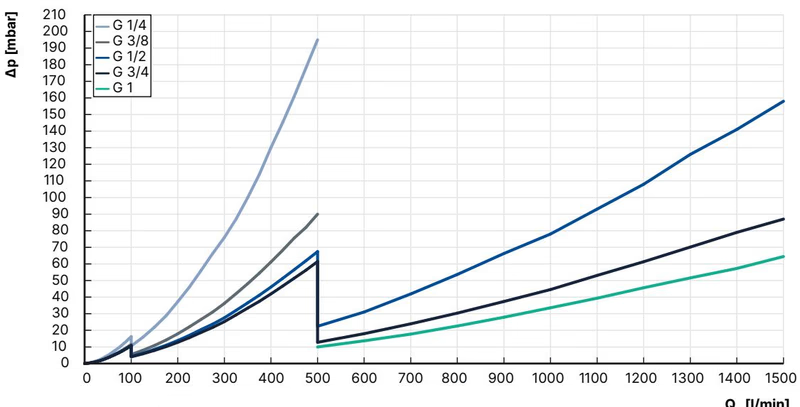
The diagram shows an example of the pressure loss curves with air flowing through. To determine the pressure loss of other gases, the corresponding air equivalent must first be calculated and the base block used for the other gas must be taken into account.
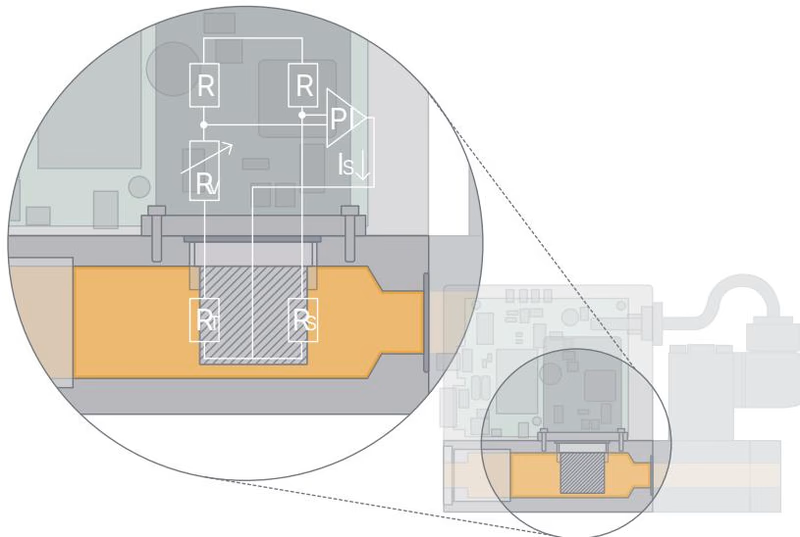
This sensor works as a hot-film anemometer in the so-called CTA operational mode (Constant Temperature Anemometer). Two resistors with a precisely specified temperature coefficient located directly in the media flow and three further resistors are connected to form a measuring bridge. The first resistor in the gas flow measures the fluid temperature, while the second, low-value resistor is always heated just enough to keep it at a fixed, specified excess temperature with respect to the fluid temperature. The heating current required for this is a measure of the heat dissipation and represents the primary measured variable.
Safety Information
The device contains electronic components that are susceptible to the effects of electrostatic discharging (ESD). Touching live parts can result in severe electric shock. Before working on the device or system, switch off the power supply and secure it against reactivation.
Explore similar products in our catalog