
Up to 99.8% Efficiency

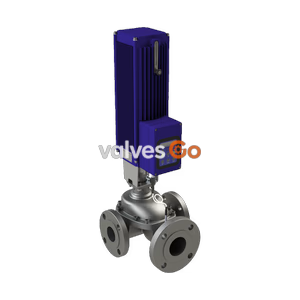
BURKERT 20076099 Type 3361 electromotive 2-way globe control valve. Features highly precise dynamic closed-loop control, 6 mm/s positioning speed, and IP65/IP67 protection.
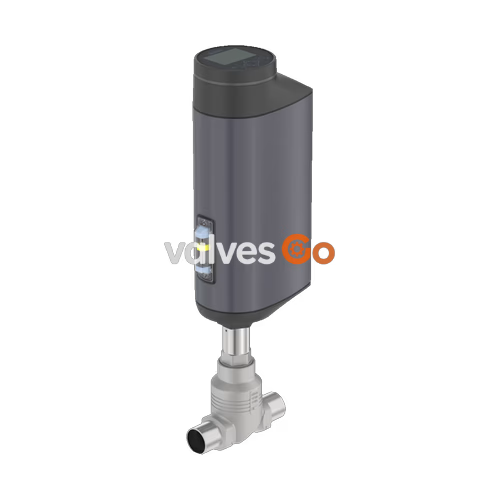
The BURKERT 20076099 Type 3361 electromotive 2-way globe control valve is the ideal solution for control tasks under demanding operating conditions. The electromotive actuator with a ball screw positions the control cone with the highest precision. A unique feature is its high positioning speed of up to 6 mm/s, which reacts almost delay-free to process signals and can be varied according to customer demands. Pressure variations or shocks in the medium are not transferred to the valve position. Each flow-optimised valve body can be equipped with up to 5 different valve seats for precise adaptation to customer needs.
Harsh environmental conditions are no problem for the Type 3361 due to its IP65/IP67 degree of protection and high impact and vibration resistance. Unrivalled service life and tightness are guaranteed by the proven self-adjusting packing gland with exchangeable V-seals. The fieldbus-compatible Type 3361 provides many helpful functions for process monitoring, valve diagnostics, and predictive maintenance.
| Product Properties | Description |
|---|---|
| Design | Globe control valve |
| Nominal diameter | DN 10...DN 100, NPS 3/8...4 |
| Safety setting in case of power failure | With energy storage SAFEPOS energy-pack: open, closed or freely programmable position. Without energy storage: blocked in last position |
| Flow direction | Against closing direction (below seat) |
| Controller variant | Positioner or process controller (option) |
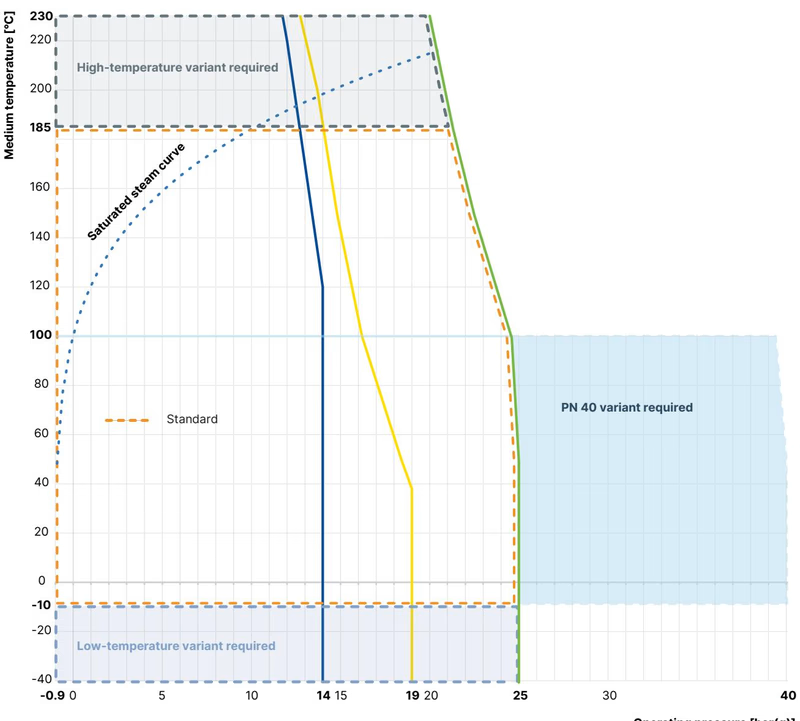
| Operating pressure | 0...25 bar(g), 40 bar(g) on request |
| Nominal pressure | PN 25/PN 40 (DIN EN 1333), Class 150 (DIN EN 1759) |
| Kv value | 0.1...140 m³/h |
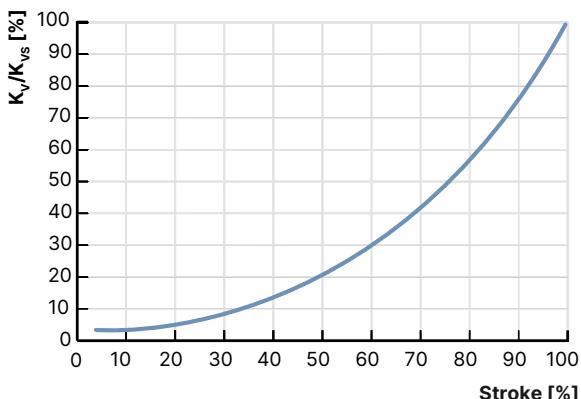
| Flow characteristic | Equal percentage, linear (on request) |
| Seat leakage | Class III, IV and VI (DIN EN 60534-4) |
| Travel speed | 6 mm/s (for AG2 actuator force 1300 N), 4 mm/s (for AG2 actuator force 2500 N), 3 mm/s (for AG3 actuator force 7700 N and 10000 N) |
| Operating voltage | 24 V DC ± 10 % (maximum residual ripple 10 %) |
| Medium temperature | -40 °C...+230 °C |
| Degree of protection | IP65/IP67 (DIN EN 60529), NEMA 4X |
| Component | Material |
|---|---|
| Spindle | Stainless steel 1.4401 (316)/1.4404 (316L) |
| Spindle seal | PTFE V-seals (filled) with spring compensation |
| Spindle guide | Stainless steel 1.4404 (316L) |
| Packing gland tube | Stainless steel 1.4401 (316) |
| Seal valve body | Graphite or PTFE |
| Seat seal | Stainless steel 1.4571 (optionally hardened), PTFE or PEEK seal washer |
| Control cone | Stainless steel 1.4571 (optionally hardened) |
| Valve seat | Stainless steel 1.4571 (optionally hardened) |
| Valve body | Stainless steel CF3M |
INFO
Dimensions in mm, unless otherwise stated. Dimensions without sealing function: the actuator is raised by approx. 2 mm in the closed position.
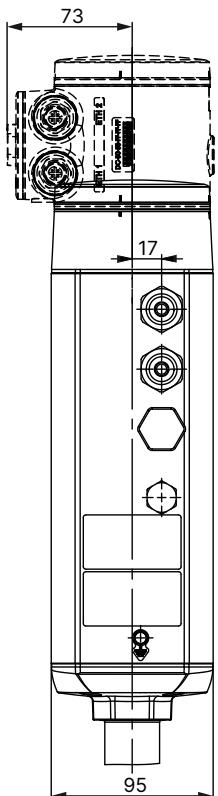
| DN | NPS | H1 Standard variant | H2 Fieldbus variant |
|---|---|---|---|
| 10 | 3/8 | 417 | 489 |
| 15 | 1/2 | 417 | 489 |
| 20 | 3/4 | 423 | 495 |
| 25 | 1 | 446 | 518 |
| 32 | 1 1/4 | 474 | 546 |
| 40 | 1 1/2 | 479 | 551 |
| 50 | 2 | 485 | 557 |
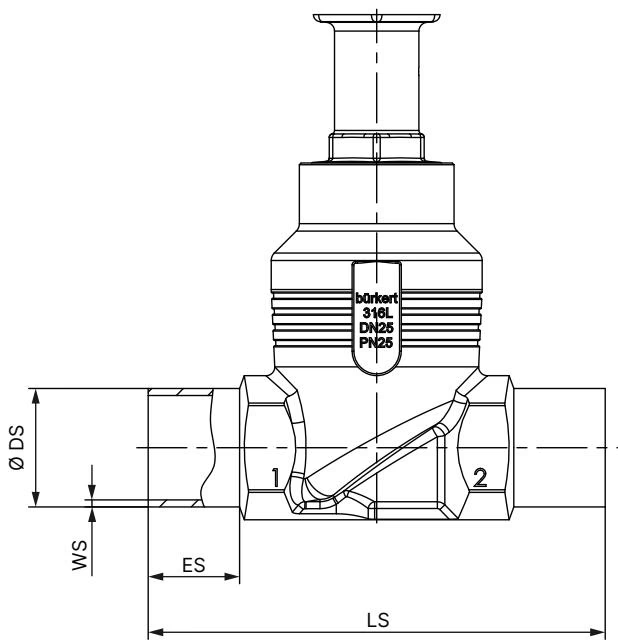
| DN | ES | LS | DIN EN ISO 1127 / ISO 4200 / DIN 11866 series B (∅ DS / WS) |
|---|---|---|---|
| 10 | 20 | 90 | 17.2 / 1.6 |
| 15 | 20 | 90 | 21.3 / 1.6 |
| 20 | 20 | 100 | 26.9 / 1.6 |
| 25 | 26 | 130 | 33.7 / 2.0 |
| 32 | 26 | 140 | 42.4 / 2.0 |
| 40 | 26 | 150 | 48.3 / 2.0 |
| 50 | 26 | 175 | 60.3 / 2.0 |
In addition to the maximum operating pressures, the application range of Bürkert process valves is limited by the nominal pressure in accordance with the relevant standard.
The electromotive linear drive consists of a brushless DC motor, a gear, and a spindle system that transfers the force to the closing element. The integrated electronics are controlled either by standard signals or via a fieldbus (digital). A positioner and a process controller are available as controller variants. The optional energy storage device SAFEPOS energy-pack is available to move the valve into a desired safety position if the supply voltage fails.
WARNING
Risk of injury from high pressure. Before working on the system or device, switch off the pressure and vent or drain lines.
TIP
Important information for the problem-free and safe functioning of the device: The sealing surface and cone contour of the control cone must not be damaged during disassembly.
Explore similar products in our catalog