
Up to 99.8% Efficiency

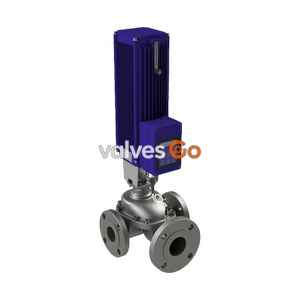
The Bürkert Type 3361 electromotive 2-way globe control valve offers highly precise, dynamic closed-loop control. Features a weather-resistant design, high positioning speed up to 6 mm/s, and optional SAFEPOS energy-pack.
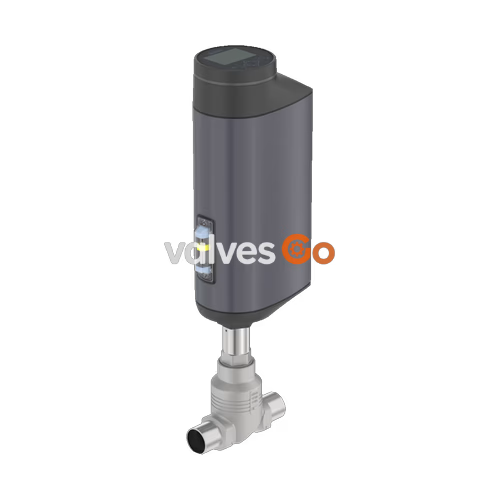
The Bürkert Type 3361 electromotive 2-way globe control valve is the solution when it comes to control tasks under demanding operating conditions. The electromotive actuator with ball screw positions the control cone with highest precision. A unique feature is its high positioning speed up to 6 mm/s that reacts almost delay-free to process signals and that can be varied according to customer demands. Pressure variations or shocks in the medium are not transferred to the valve position. Each flow optimised valve body can be equipped with up to 5 different valve seats for a precise adaptation according to customer needs. If necessary, the safety position can be approached by an optional energy storage in case of power failure. Actuator and valve are adapted perfectly to each other with closed design and robust surface.
| Product properties | |
|---|---|
| Design | Globe control valve |
| Nominal diameter | DN 10...DN 100, NPS 3/8...4 |
| Safety setting in case of power failure | With energy storage SAFEPOS energy-pack: open, closed or freely programmable position. Without energy storage: blocked in last position |
| Flow direction | Against closing direction (below seat) |
| Controller variant | Positioner or process controller (option) |
| Weight | Depending on actuator variant up to: AG2: 5.5 kg, AG3: 16 kg |
| Performance data | |
|---|---|
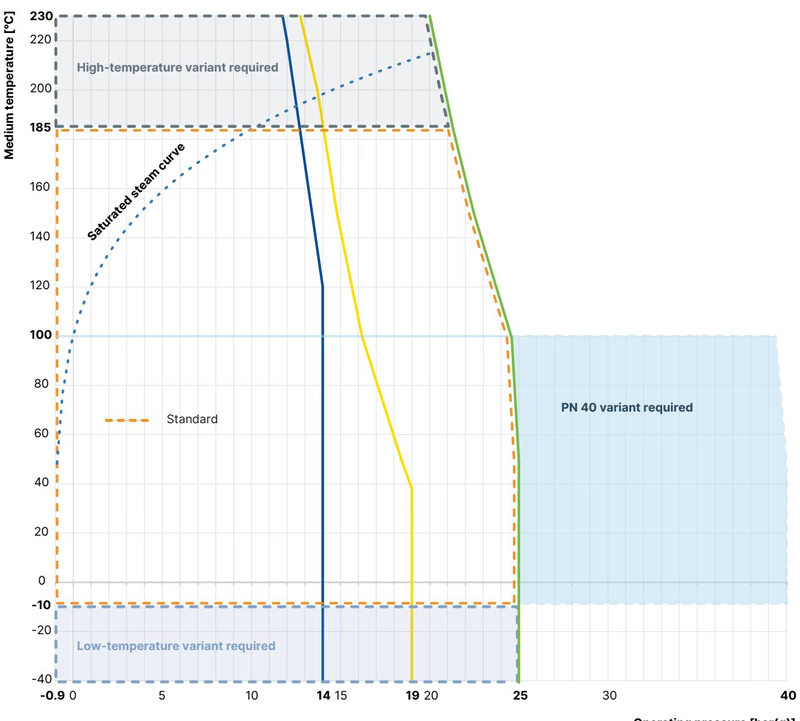
| Operating pressure | 0...25 bar(g), 40 bar(g) on request. Vacuum variant...- 0.9 bar(g) (optional) |
| Nominal pressure | PN 25/PN 40 (DIN EN 1333), Class 150 (DIN EN 1759) |
| Kvs value | 0.1...140 m³/h |
| Flow characteristic | Equal percentage, linear (on request) |
| Seat leakage | Class III, IV and VI (DIN EN 60534 - 4) |
| Closing time | AG2: 3.3...6.6 s, AG3: 8.7...12.0 s |
| Theoretical rangeability | Up to 50:1 |
| Travel speed | 6 mm/s (for AG2 1300 N), 4 mm/s (for AG2 2500 N), 3 mm/s (for AG3 7700 N and 10000 N) |
| Dead band of the position control | ± 0.1 % |
| Electrical data | |
|---|---|
| Operating voltage | 24 V DC ± 10 % (maximum residual ripple 10 %) |
| Protection class | III (DIN EN 61140) |
| Duty cycle | 100 % |
| Standby consumption | 2...5 W |
| Communication and control | |
|---|---|
| Standard signal (analogue) | Set-point value: 0/4...20 mA, 0...5/10 V and binary input |
| Fieldbus (digital) | Bürkert system bus (büS), CANopen (optional), EtherNet/IP, PROFINET, Modbus TCP, EtherCAT (optional via integrated gateway) |
| Medium data | |
|---|---|
| Operating medium | Steam, neutral gases, water, alcohols, oils, fuels, hydraulic fluids, salt solutions, organic solvents, oxygen (optional), hydrogen (optional), Iyes (optional) |
| Medium temperature | - 40 °C...+ 230 °C |
| Viscosity | Up to 600 mm²/s |
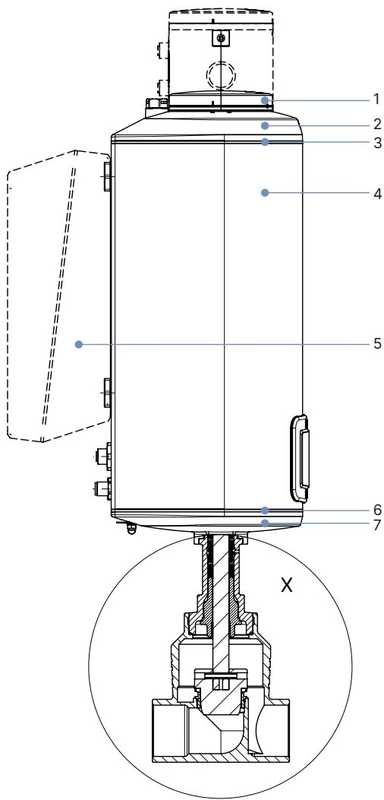
AG2 Actuator Materials:
| No. | Component | Material |
|---|---|---|
| 1 | Display housing/blind cover/gateway housing | PPS (standard), stainless steel 1.4301 (for ATEX/IECEx) |
| 2 | Actuator cover | PPS |
| 3 | Seal | EPDM |
| 4 | Actuator housing | Powder-coated aluminium |
| 6 | Seal | EPDM |
| 7 | Actuator base | PPS |
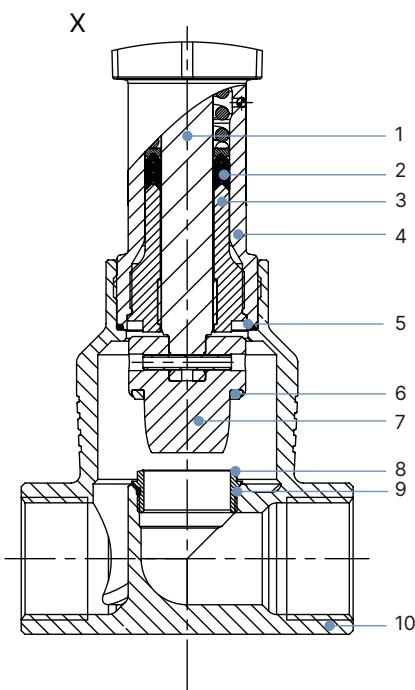
Valve Body Materials:
| No. | Component | Material |
|---|---|---|
| 1 | Spindle | Stainless steel 1.4401 (316)/1.4404 (316L) |
| 2 | Spindle seal | PTFE V-seals (filled) with spring compensation |
| 3 | Spindle guide | Stainless steel 1.4404 (316L) |
| 4 | Packing gland tube | Stainless steel 1.4401 (316) |
| 5 | Seal valve body | Graphite or PTFE |
| 6 | Seat seal | Stainless steel 1.4571 (optionally hardened), PTFE or PEEK seal washer |
| 7 | Control cone | Stainless steel 1.4571 (optionally hardened) |
| 8 | Valve seat | Stainless steel 1.4571 (optionally hardened) |
| 9 | O-ring valve seat | EPDM or PTFE |
| 10 | Valve body | Stainless steel CF3M |
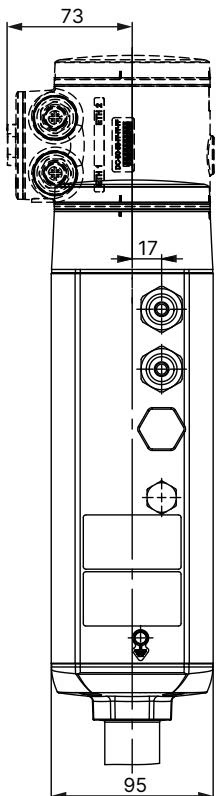
| Nominal diameter (port connection) | Height | |
|---|---|---|
| DN | NPS | H1 Standard variant |
| 10 | 3/8 | 417 mm |
| 15 | 1/2 | 417 mm |
| 20 | 3/4 | 423 mm |
| 25 | 1 | 446 mm |
| 32 | 1 1/4 | 474 mm |
| 40 | 1 1/2 | 479 mm |
| 50 | 2 | 485 mm |
In addition to the maximum operating pressures, the application range of Bürkert process valves is limited by the nominal pressure in accordance with the relevant standard.
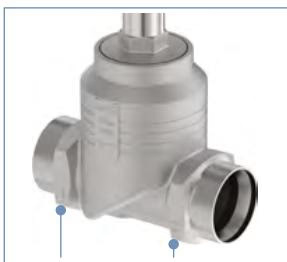
The electromotive linear drive consists of a brushless DC motor, a gear and a spindle system that transfers the force to the closing element. The integrated electronics are controlled either by standard signals or via a fieldbus (digital). A positioner and a process controller are available as controller variants. The electromotive linear actuator is designed to provide optimum efficiency. At the same time, it keeps the valve tight and in position even at the maximum specified medium pressure in a powerless standstill.
Required work steps:
Required work steps:
Explore similar products in our catalog